Sustainability
After the formation of the Lake Lemon Conservancy District (LLCD) in 1995, the City of Bloomington Utilities Department executed a fifty (50) year lease agreement with the LLCD. The LLCD set off with the mission to operate, maintain, and manage Lake Lemon for generations to come. New to the practice of managing reservoirs, the LLCD quickly encountered the plethora of issues surrounding lake management. Current sustainability issues include sedimentation, water quality, aquatic vegetation control, shoreline erosion control and wildlife management.
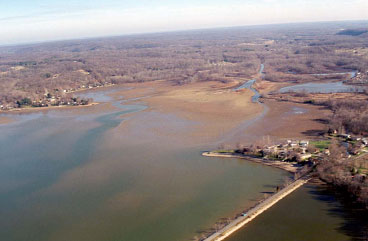 Sedimentation is the number one threat to man made reservoirs. When not actively addressed, the “filling in” of reservoirs with sediment is an inevitable fate. Sediment enters Lake Lemon primarily through the erosion of shoreline material and as particulate matter carried into the lake by Bean Blossom Creek, Lake Lemon’s main tributary. When the lake was initially formed, it had an estimated life expectancy of 125 years. Nearing the expected half life of Lake Lemon, the impacts of sedimentation have become clear and the need for an active sediment removal program proven. In 1999, the LLCD applied for and received a federal Clean Water Act (CWA) Section I04(b)(3) grant from the Indiana Department of Environmental Management (IDEM) for a sedimentation/restoration preliminary design study. An in depth analysis of current sediment loads was preformed and maps were created identifying critical areas. An LLCD Freeholder Sediment Removal Project Committee, consisting of members from each sub-area of the district, was created and charged with the responsibility of identifying sediment disposal sites and creating a dredging priority list. This task was completed in the spring of 2006.
Sediment Depth, Bathymetry, and Volume Assessment Report | Map
2014 Sediment Depth, Bathymetry, and Volume Assessment Report | Map
2019 Lake Lemon Bathymetric Map
2025 Lake Lemon Bathymetric Map
The members of the committee were as follows:
District – Freeholder Representatives
- District I – Larry Polley and Mike Sonneborn
- District II – Dave Keller and Hank Berman
- District III – Mark Moser and Boyd Sturdevant
- District IV – Ed Roehling and Gene Niednagel
- District V – Roger Watkins and Gail Tala
- District VI – Jim Scrimager and William Weber
- District VII – Mike Grady and Rob Casserotti
Please click on the link below to see priorities made by the SRP Committee for each district.
Below are two links: Interactive Sediment Map and Printable Sediment Map. The interactive map allows the user to view the entire lake and zoom in on any given location. Once zoomed in to the area of interest, the user can click on the proposed dredging area (as indicated by the tip of a yellow, light yellow or blue marker) and a popup will give a brief summary of proposed activity. The printable map can be downloaded and viewed using Adobe Acrobat Reader.
After identifying critical areas, the LLCD contracted the services of Payne Excavating to begin dredging the lake and applying rip-rap to eroding City of Bloomington shoreline. Between 2006 and 2008, over thirty thousand (30,000) cubic yards of sediment was removed. For individual maps of the Sediment Removal Areas completed in 2006, 2007 and 2008 along with a short description, click the following .PDF links:
SRP MAP 2006 116 | SRP MAP 2006 208 | SRP MAP 2006 304) | SRP MAP 2007 117 | SRP MAP 2007 131 | SRP MAP 2007 110 | SRP MAP 2008 133
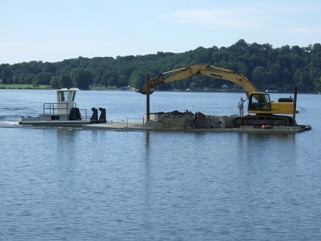 After 3 years of the contracted dredging operation, the LLCD decided to endeavor in a self-owned and operated sediment removal program. During 2009, no dredging took place as the LLCD began accepting bids for the necessary equipment and began financial preparations for the purchase. In May of 2010, the equipment was purchased and included a newly built Barge and Push Boat. The operation hit the ground running in June, 2010. Currently, dredge material from the eastern end of the lake must be transferred the length of the lake for disposal, however, the recent acquisition of two east end disposal sites is expected to nearly double the amount of material removed on an annual basis.
The Lake Lemon Conservancy District Board of Directors at the February 6, 2013 Annual Board Meeting, by consensus, authorized a re-structured Dredging Study Group. The Study Group will have representation from all seven (7) sub-areas of the District. The purpose of the Study Group is to study our current Sediment Removal Program’s efficiency and effectiveness, and to make future recommendations to the entire LLCD Board of Directors. The Dredging Study Group ‘will consist of three District Directors, LLCD staff, and up to four additional Freeholders. Dredging Study Group Contact List as of 8/26/14
| Introduction |
| LLCD Private Dredging Service Agreement | LLCD Private Dredging Service Sign Up Sheet |
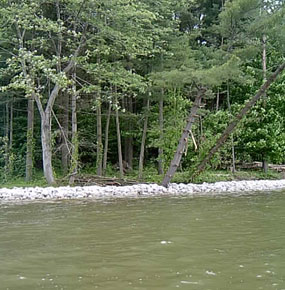
Shoreline erosion control is very important to maintaining the aesthetic and biological integrity of Lake Lemon. The primary method of shoreline erosion prevention is through the application of gabion stone known as rip-rap. When properly installed, rip-rap can provide an effective, long-term protection from wave wind and ice action. There are also ecological advantages in using rip-rap. Aquatic insects, which are important food for young fish, find shelter in the stones. Rooted plants can also grow between the stones, thereby providing additional shoreline stabilization and a more natural look to the rip-rap. It is important to make sure that rip-rap is properly installed to insure the benefits listed.
 As a public recreational water body, Lake Lemon must maintain strict water quality standards set by the Indiana Department of Environmental Management (IDEM) and the State Board of Health. In order to keep a close eye on water quality, and remain in compliance with the State Board of Health, weekly water samples are taken from the beach swimming area. The samples are analyzed for fecal coliform, which is inclusive of many different species of potentially harmful bacteria. In order to obtain in depth analysis of water quality parameters, the LLCD has contracted Indiana University’s School of Public and Environmental Affairs (SPEA). Twice a year, with the help of SPEA graduate students, noted IU SPEA Limnologist Bill Jones performs a total water quality parameter analysis and produces an annual water quality report. The first annual water quality report was created in 2000 and has continued to the present allowing the LLCD to monitor current conditions and long term trends. The current LLCD lake biologist also serves on the Bean Blossom Watershed Steering Committee. “Reducing sediment loads, nutrient input and promoting best management practices within a watershed is a vital part of lake management as water quality within a lake is a direct reflection of the surrounding watershed” states former LLCD biologist Adam Casey. Lake Lemon Watershed Management Plan
Water Quality Reports: 2006 | 2007 | 2008 | 2009 | 2010 | 2011 | 2012 | 2013 | 2014 | 2015 |2016 | 2017 | 2018 | 2019 | 2020 | 2021 | 2022 | 2023 |2024 |2025
For water quality reports prior to 2006 please contact the LLCD office.
Our Address & Map
- office@lakelemon.org
- TEL: (812) 334-0233
- FAX: (812) 335-0038
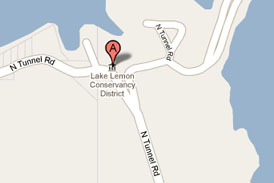
- 7599 N Tunnel Road, Unionville, IN 47468
Latest News
-
The Beach has Closed at Riddle Point Park
It’s a wrap! Riddle Point Park Beach is now closed for the season. […]
-
October 22 2026, LLCD Board of Directors Meeting & Adoption of the 2027 Budget
The next scheduled LLCD board meeting, and the adoption of the 2027 LLCD […]
-
Donate to Lake Lemon !
The Lake Lemon Enhancement Funds have been established to provide for protection of […]
